

If you’ve started looking into skilled migration to Australia as an engineer, you’ve probably already come across the term ‘CDR’ and wondered exactly what is CDR report and whether it’s actually something you need to worry about. The CDR is a specific document submitted to a particular assessing body for a pretty specific reason, and confusion about its scope is one of the major reasons engineers end up wasting weeks researching the wrong pathway.
This guide answers the question straight out. We’ll cover what a CDR report is, what it’s used for, who needs to prepare one, and how it differs from other documents like KA02 reports for New Zealand and ACS RPL reports for ICT professionals. By the end of it, you’ll know whether the CDR pathway is something you need to think about and what the next step should be.
If you’re already convinced you need to put in the work, our complete guide to the Competency Demonstration Report is the place to go for a deep dive on how to actually get it done. For now, let’s get back to the basics: what is CDR report, and is it something you need to worry about?
What is a CDR Report? – The Definition
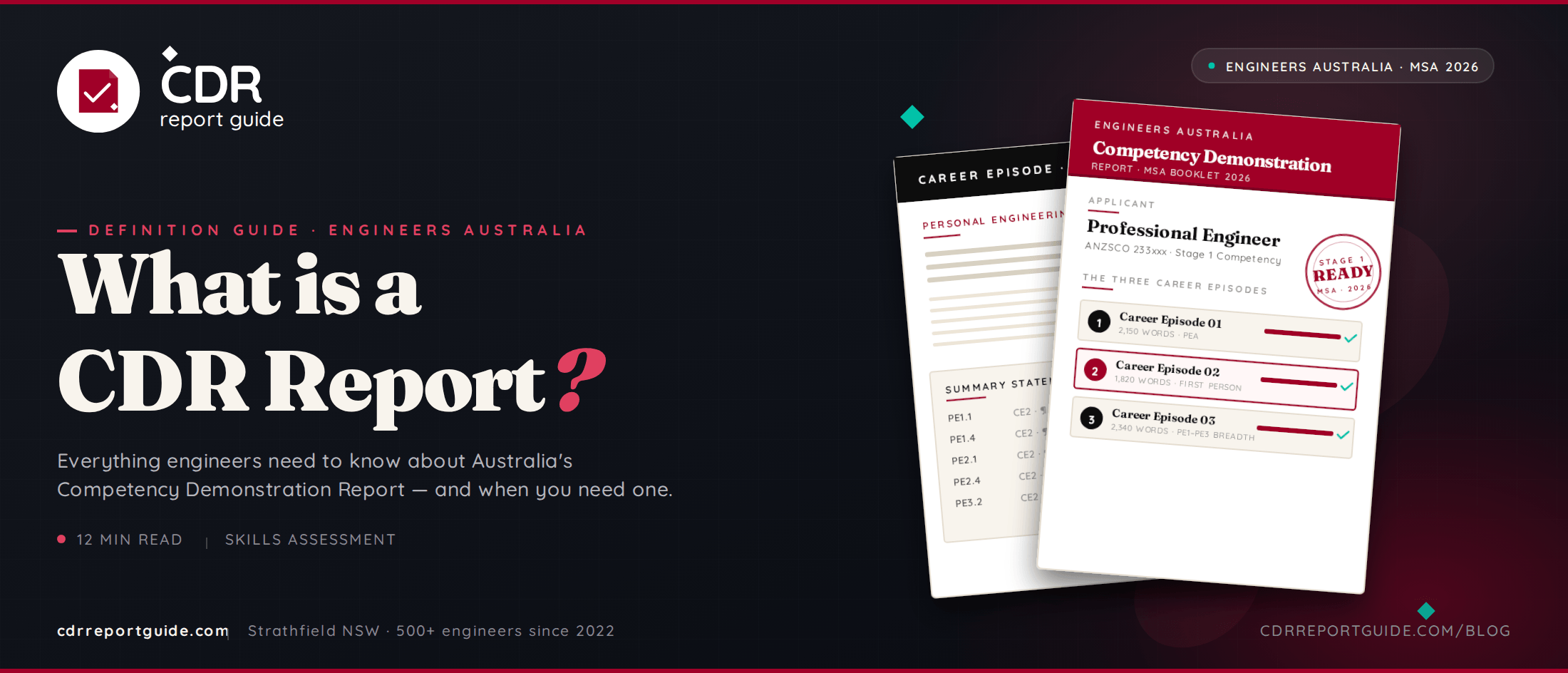
A CDR report – short for Competency Demonstration Report – is a technical document that engineers submit to Engineers Australia when they’re trying to get a skilled migration assessment for their qualifications, but they aren’t formally recognised under the Washington Accord. The report proves that you’ve got the education, knowledge and actual experience of an Australian-trained engineer, even if your specific degree isn’t automatically recognised.
In plain language: the CDR is how you show Engineers Australia that you’ve got the engineering skills of an Aussie-trained engineer, when your degree on its own doesn’t automatically prove it. It’s an alternative to the qualification recognition pathway you can go through if your degree is accredited through the Washington Accord.
The CDR’s not just a generic collection of your engineering work, your CV with some extra pages, or a personal statement. It’s a structured document with specific components, word counts, voice rules, and requirements for mapping your skills. Engineers Australia uses it to make a yes-or-no decision: does this applicant have the engineering skills to match a four-year accredited engineering degree?
What’s Inside a CDR Report?
Every CDR report the Engineers Australia gets contains the same five components:
- Personal information and CV – a bit of personal info plus a complete record of your engineering jobs
- Continuing Professional Development (CPD) record – a single A4 page showing all the learning activities you’ve done since you graduated
- Three Career Episodes – narratives of 1,000-2,500 words each that describe engineering work you’ve actually done yourself
- Summary Statement – a table that links Engineers Australia’s 16 competency elements to specific parts of your Career Episodes
- Supporting documents – copies of your degree, transcripts, work references and English language test results
The Career Episodes are where the writing effort really starts to kick in. Each episode follows a four-section structure (Introduction, Background, Personal Engineering Activity, Summary), uses the first person throughout, and shows off your engineering skills through real project work. For a walkthrough of how to actually get this done, check out our guide on how to write a Career Episode for Engineers Australia.
The Summary Statement might be simple in structure but it’s actually the hardest part to get right. It’s a table that points to specific paragraphs in your Career Episodes for each of Engineers Australia’s 16 competency elements. If you get the references all wrong – where your Summary Statement says an element is demonstrated in a paragraph that doesn’t actually demonstrate it – that’s likely to be the reason your CDR gets rejected.
What is the Purpose of a CDR Report?
The CDR exists to give Engineers Australia a clear idea of whether you’ve got the skills to get a competent engineer’s job in Australia, based on your qualifications alone isn’t enough. There are three main reasons it exists:
To demonstrate your knowledge. Engineers Australia needs to see that your education was as good as an Australian engineering degree – that you covered the same subjects, for example, and had the same kind of experience. The CDR’s narrative format lets you show that in a way a transcript alone can’t.
To demonstrate your applied skills. Beyond what you studied, the CDR shows what you’ve actually done as a practicing engineer. The Career Episodes tell a story of the engineering decisions you made, the problems you solved, and the outcomes you delivered. This is what separates the CDR from a pure qualification recognition exercise.
It’s worth noting that I removed some of the “Designer’s Note” sections as they seemed to be specific to an internal process or design note and were not relevant to the text itself.To get a positive outcome for your skills assessment to migrate to Australia. The CDR is a key part of the Engineers Australia skills assessment process, under the Migration Skills Assessment program. A positive outcome will help support your visa application, whether that’s for a Subclass 189, 190, or 491 visa – or one of the other engineering-occupation visa pathways through the Department of Home Affairs.
When Do I Need to Submit a CDR Report?
You’re going to need a CDR report from Engineers Australia in the following situations:
- You’ve got an engineering degree from a country that isn’t a Washington Accord signatory – that includes countries like China, Iran, Egypt, Vietnam, Indonesia, the Philippines, Nigeria, and many others outside of the Accord
- Your degree is from a Washington Accord country, but your specific institution or program isn’t accredited under the Accord. That’s the case for lots of universities in India, Pakistan, Bangladesh, and Sri Lanka, even though their countries are Accord signatories
- You completed your engineering education through non-traditional pathways (like technical institutes, military programs, or distance education) that don’t have direct Accord recognition
- You’re applying to be assessed in one of Engineers Australia’s four occupational categories: Professional Engineer, Engineering Technologist, Engineering Associate, or Engineer Manager
You do not need a CDR in the following cases:
- Your engineering qualification is from an institution that’s accredited under the Washington Accord (Australia, New Zealand, the US, the UK, Canada, Ireland, Germany, Japan, Singapore, and others). In that case, qualification recognition moves a lot faster and doesn’t require Career Episodes
- You’re an ICT professional rather than a traditional engineer. That means if you’re a software engineer, network engineer, cyber security specialist or data engineer, you’ll go through the Australian Computer Society’s RPL pathway, not Engineers Australia’s CDR
- You’re applying for skilled migration to New Zealand. New Zealand uses a different document system for non-Accord engineers, the KA02 Knowledge Assessment, which has different requirements than a CDR
How Does a CDR Compare to Other Engineering Migration Documents?
The CDR is just one of several skills assessment documents used in the migration process. Knowing how they all fit together can save you from getting the wrong one and having to start over.
| Document | Submitted To | For Whom | Document Components |
|---|---|---|---|
| CDR | Engineers Australia | Engineers from non-Accord countries applying to Australia | 3 Career Episodes + Summary Statement + CPD + CV |
| KA02 | Engineering New Zealand | Engineers from non-Accord countries applying to New Zealand | 3–4 Work Samples + Knowledge Profile self-assessment + CPD |
| ACS RPL | Australian Computer Society | ICT professionals without recognised ICT qualifications | 2 Project Reports + Key Areas of Knowledge narrative |
| KA01 | Engineering New Zealand | Engineers with Accord-recognised qualifications applying to New Zealand | Streamlined qualification recognition only |
The CDR and KA02 share some similarities on the surface, but they’re used for different purposes and have quite different requirements.
If you’re targeting both Australia and New Zealand, we’ve put together a helpful resource that covers the combined CDR + KA02 trans-Tasman pathways.
If you’re an ICT professional, the ACS RPL is the document you need, not the CDR. The ACS uses two Project Reports against their own framework, while the CDR is three Career Episodes against EA’s competency elements. Submit the wrong document to the wrong assessing body and it can be a costly mistake.
Who Will Review My CDR?
Engineers Australia assigns your CDR to an assessor with experience in your nominated ANZSCO occupation’s field. A CDR for civil engineering will go to a civil engineer, a mechanical CDR to a mechanical engineer, and so on. The assessor will read through your whole CDR, cross-reference the Summary Statement against the actual content of your Career Episodes, run plagiarism and AI-content detection scans, and then send you an outcome letter.
The outcome can be positive – suitable – or not so good – not suitable – but serious cases involving plagiarism or fabrication can even get you banned from resubmitting for a year.The standard assessment timeline is usually around 12-16 weeks for a standard processing or a snappy 10 working days for the AUD 1,815 Express service – if you can afford to shell out that extra cash. The standard assessment fee will be AUD 907.50, paid on the nose to Engineers Australia at the time of submission – no dodgy invoicing or payment excuses here.
What Happens If Your CDR Doesn’t Measure Up?
Don’t panic if your CDR doesn’t fly – a rejected one isn’t the end of the world. Yeah, it’s going to cost you a bit more time and money, but at least you’ve got a chance to fix it. Most rejections are down to things like not quite having the experience to back up your claims (you claim you’re a whiz with engineering, but your work history says otherwise) or copying bits of other people’s work from some obscure database that EA’s got access to or just using a bit of AI to make your writing sound more interesting.
You can send it back in after you’ve sorted out the problems that were pointed out in the rejection letter. The annoying thing is that you’ll need to pay for the assessment again. If it was a case of plagiarism or AI-generated content, you might even get hit with a 12-month ban from submitting again – that’s not ideal and not only will you need to find someone else to help you fix it, but you’ll also need to make sure that person hasn’t seen the original dodgy content or they might accidentally re-use the same patterns.
If you do end up with a rejected CDR, our plagiarism removal and rewriting service is pretty good at helping people get back on track. We rebuild the affected sections with a fresh writer.
Need Help Preparing Your CDR?
There are a lot of us at CDR Report Guide who’ve helped people get their 500+ CDRs in over the past couple of years. We’re a team of qualified engineers and professional writers who know their stuff – so each CDR we draft is done by someone who’s got subject expertise in the right area. Electrical CDRs go to writers with electrical engineering expertise, and so on.
If you’re not sure if the CDR pathway is the right one for you, we’ve got a free 15-minute chat that’ll sort you out. And the truth is, about one in eight people who come to see us end up being able to use a recognition pathway instead – and that means no need for our service at all! We’d rather help you out and make sure you’re on the right path rather than try to sell you something you don’t need. You can find us on the home page or book a consultation right away.
Frequently Asked Questions
Is a CDR the Same as a SOP (Statement of Purpose)?
Nope. These are two very different documents that serve two very different purposes. A Statement of Purpose is the sort of thing you write for university admissions – it’s all about your academic and career goals. A CDR, on the other hand, is a technical document that you submit to Engineers Australia for skills assessment – and it’s got its own set of rules and guidelines to follow. EA won’t accept Statements of Purpose instead of CDRs.
Can I Write a CDR if I’m Still at Uni?
CDRs require evidence of actual engineering experience – you know, the kind you get from a real job. Most students don’t yet have that because they’re still at uni. In some cases, Engineers Australia will accept student projects as part of your CDR, but it’s going to be a lot harder to demonstrate Stage 1 engineering competency on the basis of coursework rather than actual work experience. If you’re still a student, you’re probably better off waiting until you’ve got a real job under your belt.
How Long Does a CDR Report Need to Be?
The total length of a CDR report is usually between 6,000 and 8,000 words across all five components. Each Career Episode needs to be between 1,000 and 2,500 words. The Summary Statement is a bit different – it’s a table rather than a big block of writing, and the CPD fits on a single A4 page. There’s no maximum word count, but if you go over the limits for each component, your CDR will get rejected.
Does a CDR Guarantee a Positive Skills Assessment?
Nope. Even if you do everything right and produce a top-notch CDR, there’s no guarantee that you’ll get a positive outcome. The actual decision is up to Engineers Australia – they’ll assess whether your experience matches up to Stage 1 competency at the right level. And even if your CDR is perfect, there are other factors that can affect the outcome – like whether you’ve got the right qualifications, whether your English is up to scratch, and whether your documents are all in order.
How Much Does it Cost to Prepare a CDR?
Engineers Australia slaps an AUD 907.50 fee on standard CDR assessments (or AUD 1,815 for some sort of Express magic trick if you want it done fast), payable directly to them the moment you submit your application. Specialist CDR writing services in Australia seem to be all over the shop, with prices ranging from AUD 599 to AUD 1,599 depending on just how fast you need it done. If you’re doing it yourself, you get off scot free – that is, apart from spending 2-4 months of your precious time toiling away on it in your spare moments. When you add the assessment fee to the cost of a professional writer if you decide to go that route, the whole shebang really comes in anywhere between AUD 907.50 and AUD 2,500.
Final Word
Getting through the door to skilled migration in Australia as an engineer without the right qualifications is not easy – in fact, the CDR report is basically the key that unlocks the whole shebang. But the thing is, it’s not just some piece of paper – a CDR report is a seriously in-depth document that Engineers Australia takes very, very seriously.
So if you suspect that being a CDR is the way to go for you, then the next step is to get a handle on what the whole thing is all about. Start with our CDR guide, for a start – that’ll give you a complete overview of the document and all its ins and outs. And if you’re totally clueless about whether the CDR path is even an option for you, then grab a free 15 minute chat with a senior engineer and he’ll sort you out.