

If you’re an engineer planning to migrate to Australia under the skilled migration program, the Competency Demonstration Report (CDR) is the single most important document between you and a positive skills assessment outcome. The CDR is what Engineers Australia — the official assessing authority appointed by the Department of Home Affairs — uses to evaluate whether your engineering education and experience meet Australian standards.
This complete guide covers everything you need to know about preparing a Competency Demonstration Report for Engineers Australia in 2026: what goes into the document, how the assessment works under the new MSA Booklet 2026 specification, what gets CDRs rejected, and how to give yours the best chance of approval on the first submission.
Whether you’re applying for a Subclass 189, 190, or 491 visa, the CDR is the foundation of your migration skills assessment. Get it right and you receive a positive outcome that supports your visa application; get it wrong and you face a 12-week resubmission delay, the AUD 907.50 reassessment fee, and — for plagiarism or AI-content rejections — a possible 12-month resubmission ban.At CDR Report Guide, we’ve helped 500+ engineers navigate this process since 2022
What is a Competency Demonstration Report (CDR)?
A Competency Demonstration Report is a structured technical document submitted to Engineers Australia by engineers whose qualifications are not formally recognised under the Washington Accord. The CDR exists to demonstrate that your engineering knowledge, experience, and competency meet the standard of a Washington Accord–accredited engineering degree, even when your specific qualification isn’t.
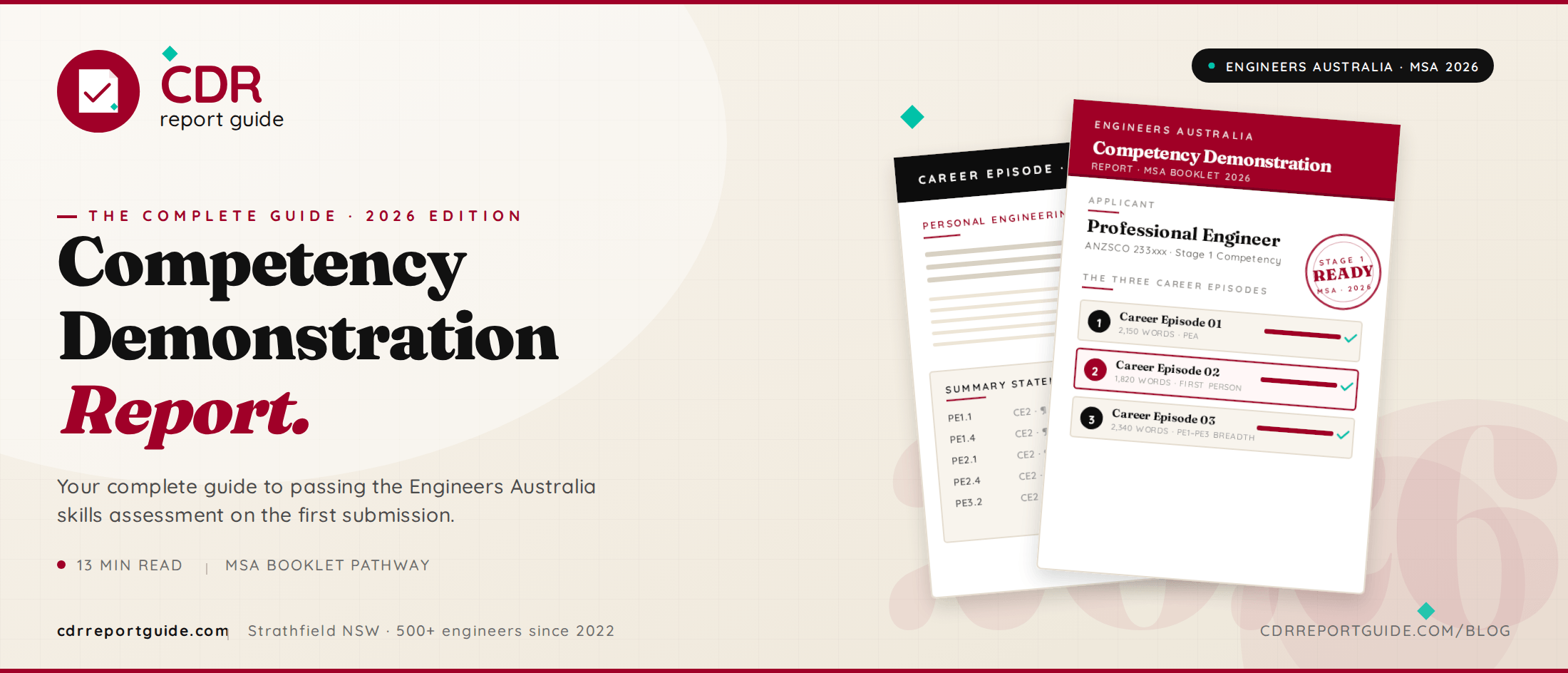
The document is structured around three Career Episodes — narrative accounts of engineering work you have personally performed — plus a Summary Statement that maps Engineers Australia’s competency elements to specific paragraphs in those episodes. It also includes a continuing professional development record, your CV, and supporting documents verifying your identity, education, and employment.
EA uses the CDR to make a specific yes/no decision: does the applicant demonstrate Stage 1 engineering competency at the level of a four-year accredited engineering degree? Everything in the document must serve this purpose. For a foundational explanation of what makes a CDR distinct from other engineering documents, see our companion guide on what a CDR report is and when you need one.
Who Needs to Submit a CDR to Engineers Australia?
Engineers Australia uses the CDR pathway specifically for engineers from countries or institutions not covered by the Washington Accord, the Sydney Accord, or the Dublin Accord. If your country and institution are recognised under one of these accords, you don’t need a CDR — your qualification is recognised through a streamlined verification pathway instead.
You need to submit a CDR if:
- Your engineering degree is from a country that is not a Washington Accord signatory (China, Iran, Egypt, Vietnam, Indonesia, the Philippines, Nigeria, and many others)
- Your degree is from a Washington Accord country, but the specific institution or program isn’t accredited under the Accord
- You completed your education through non-traditional pathways but practice as an engineer
- You’re applying to be assessed in one of the four EA categories: Professional Engineer, Engineering Technologist, Engineering Associate, or Engineering Manager
If you’re an ICT professional rather than a traditional engineer — software engineer, network engineer, cyber security specialist — you don’t need an EA CDR. You need an ACS RPL submission through the Australian Computer Society instead. We cover that pathway separately on our services overview. For New Zealand migration, engineers from non-Accord countries need a KA02 Knowledge Assessment, not a CDR.
THE FIVE COMPONENTS OF A CDR
DESIGNER NOTE —Most important section of the post. 5 numbered components, each with H3 + 2 paragraphs. Internal links woven into the Career Episodes and Summary Statement components.
The Five Components of a CDR Report
Every CDR submission to Engineers Australia contains the same five components. Each one serves a distinct purpose in the assessment, and missing or weak components are the most common reason CDRs get rejected at intake before the assessment even begins.
1. Personal Information and Curriculum Vitae
This component covers your full identity verification — passport details, contact information, and a complete chronological CV showing every engineering position you’ve held. The CV must include employer name, job title, dates of employment, and a brief description of duties for every role. Gaps in employment history must be explained.
The CV is more than a formality. EA assessors cross-reference your CV against the Career Episodes you submit to confirm the engineering activities you describe match positions you actually held. Inconsistencies between the CV and Career Episodes trigger clarification requests and slow your assessment.
2. Continuing Professional Development (CPD) Record
The CPD is a chronological table of every professional development activity you’ve completed since graduation: workshops, conferences, technical training, professional reading, certifications, and self-directed learning. EA expects to see ongoing engagement with your engineering field beyond your initial qualification.
The CPD must fit on a single A4 page in landscape orientation, with columns covering date, activity title, hours, organising body, and brief description. For more on CPD format and what to include, see our guide on continuing professional development for CDR.
3. Three Career Episodes
The Career Episodes are the heart of the CDR — three separate narratives of 1,000–2,500 words each, describing engineering activities you have personally performed. Each episode follows a defined four-section structure: Introduction, Background, Personal Engineering Activity, and Summary.
The middle section, Personal Engineering Activity (PEA), is the most important. It must be 500–1,500 words, written entirely in first-person voice, and describe specific engineering work you personally performed — not work your team did, not work your company did, but engineering decisions and activities that demonstrate your individual competency. Voice slips into ‘we’ or ‘the team’ weaken every Career Episode they appear in. For a deep walkthrough of how to structure each episode, see how to write a Career Episode for Engineers Australia.
4. Summary Statement
The Summary Statement maps EA’s competency elements to specific paragraph numbers in your Career Episodes. EA’s three Stage 1 competency categories — Knowledge and Skill Base (PE1), Engineering Application Ability (PE2), and Professional and Personal Attributes (PE3) — break down into 16 specific elements that must each be evidenced somewhere in your three Career Episodes.
The Summary Statement is a structured table where each competency element points to specific paragraphs in your Career Episodes that demonstrate that element. EA assessors use this table as their primary tool for evaluating your CDR. Mismatched references — where the Summary Statement claims an element is demonstrated in a paragraph that doesn’t actually demonstrate it — are the single biggest cause of CDR rejection. Our detailed guide on the CDR Summary Statement and competency cross-referencing covers exactly how this works.
5. Supporting Documents
The final component covers everything that verifies the claims made elsewhere in the CDR: attested copies of your engineering degree certificate and academic transcripts, employment reference letters from every employer mentioned in the CDR, English language test results (IELTS, PTE, or TOEFL), and your passport bio page. Document attestation requirements vary by country of origin and require specific notarisation that EA accepts.
The Four Engineering Categories Assessed by Engineers Australia
EA assesses CDRs in four occupational categories, and your nominated ANZSCO occupation determines which category your CDR falls into. The competency standard expected of each category is different, so the depth and complexity of your Career Episodes must match what EA expects for that category.
| Category | Typical Background | ANZSCO Code Range |
|---|---|---|
| Professional Engineer | 4-year engineering bachelor’s degree | 233xxx |
| Engineering Technologist | 3-year engineering technology degree | 233914 and others |
| Engineering Associate | 2-year engineering associate degree or advanced diploma | 312xxx |
| Engineering Manager | Engineering background plus management experience | 133211 |
Choosing the wrong category — or selecting an ANZSCO code that doesn’t match your actual work — is one of the leading causes of negative CDR outcomes. Engineers Australia compares your Career Episodes against the duty descriptions for your nominated category, and mismatches lead to rejection regardless of how well-written the CDR is.
MSA Booklet 2026: What Has Changed
The Migration Skills Assessment Booklet — known simply as the MSA Booklet — is the official Engineers Australia document that defines the structural and content requirements for every CDR submission. The 2026 revision introduced several changes that affect every CDR being submitted right now.
Key changes in MSA Booklet 2026:
- AI-generated content is now a separate rejection category.EA introduced statistical AI-content detection in 2026, distinct from plagiarism detection. CDRs drafted with ChatGPT, Claude, Gemini, or paraphrasing tools can be rejected even when the content isn’t copied from any specific source.
- Personal Engineering Activity word count is more strictly enforced.The 500–1,500 word range for the PEA section was a guideline in older booklets; in 2026 it’s a hard structural requirement.
- Cross-section consistency checks.EA’s tooling now flags CDRs where some sections show distinctly different writing styles than others, suggesting different authorship across the document.
- Updated competency element wording.The 16 competency elements within PE1, PE2, and PE3 received clarification updates that affect what evidence assessors expect to see.
Every CDR being prepared in 2026 should be drafted against the current MSA Booklet, not an older version. Several free CDR-checklist sites still mirror the 2020 booklet, which can mislead self-applicants.
The CDR Submission Process: Step by Step
The full process from preparation to outcome typically takes 4–6 months when self-prepared and 3–5 months when professionally drafted. Here’s the standard flow:
- 1. Determine your eligibility and nominated ANZSCO occupation.Confirm you actually need a CDR (rather than qualification recognition under an Accord) and select the ANZSCO code that best matches your work.
- 2. Prepare your supporting documents.Get attested copies of your degree, transcripts, employment letters, and English test results. Document attestation alone can take 2–4 weeks depending on country.
- 3. Identify three suitable engineering projects.Each project must demonstrate complex engineering activity, must be work you personally performed, and the three projects together must collectively cover all 16 competency elements.
- 4. Draft the three Career Episodes.First-person voice, 1,000–2,500 words each, with the PEA section between 500 and 1,500 words.
- 5. Build the Summary Statement.Map each of EA’s 16 competency elements to specific paragraph numbers in your Career Episodes — by paragraph reference, not by general claim.
- 6. Compile the CPD record and CV.Single-page CPD; complete chronological CV.
- 7. Run plagiarism and AI-content scans before submission.EA’s detection routines catch issues that aren’t obvious by eye. Pre-submission scanning prevents costly rejections.
- 8. Submit through MyPortal.Pay the AUD 907.50 standard assessment fee (or AUD 1,815 for Express) and wait for the outcome letter, typically 12–16 weeks for standard processing.
For a deeper walkthrough of EA’s published process and timelines, see our cluster post on the Engineers Australia skills assessment process.
Common Reasons CDRs Get Rejected (and How to Avoid Them)
Across the submissions we’ve delivered since 2022 and the recovery work we’ve done on rejected CDRs, the rejection patterns are predictable.
The most common rejection causes:
- Summary Statement paragraph references that don’t match the actual content.Self-writers often paraphrase the competency requirements rather than cross-reference them — leading to claims that don’t hold up under assessor review.
- Voice slipping into ‘we’ or ‘the team’ in Personal Engineering Activity sections.EA wants evidence of your individual competency, not your team’s.
- Career Episodes that all describe the same type of engineering activity.Three structural design projects don’t demonstrate breadth across competency elements.
- Plagiarism from online CDR samples or research papers.Engineers Australia stores every CDR ever assessed in an internal database. Paraphrasing doesn’t fix it.
- AI-generated content patterns.EA’s 2026 detection routines identify ChatGPT, Claude, Gemini, and paraphrasing-tool output even after heavy human editing.
- Wrong ANZSCO occupation match.Career Episodes describing work that doesn’t align with the duties of your nominated occupation.
- Word count violations.Career Episodes outside the 1,000–2,500 range or PEA sections outside 500–1,500 words trigger automatic structural flags.
For more rejection patterns and what to do if your CDR has already been rejected, our complete guide to CDR rejection recovery covers the full picture, and the plagiarism and AI detection guide explains exactly how EA’s 2026 detection works.
Why Choose CDR Report Guide for Your Competency Demonstration Report
CDR Report Guide is a Strathfield NSW–based writing services firm that has prepared 500+ skills assessment submissions since 2022.
What distinguishes our CDR writing service is the discipline-matched assignment model: a petroleum engineering CDR is drafted by a writer with subject expertise in petroleum engineering, a structural CDR by a writer with structural engineering expertise.
If you’ve already drafted your own CDR, our CDR review service provides a senior-reviewer audit before submission — significantly cheaper than the AUD 907.50 reassessment fee that comes with rejection. If your CDR has already been rejected for plagiarism or AI-generated content, our plagiarism removal and rewriting service handles recovery cases by rebuilding the affected sections with a fresh writer.
The free 15-minute consultation isn’t a sales call. It’s a path-confirmation conversation: we tell you which service you need, including when the answer is that you don’t need any service at all because your situation qualifies for a streamlined recognition pathway instead.
CDR Report Cost and Timeline
Professional CDR writing in Australia ranges from AUD $599 to AUD $1,599 depending on delivery speed. CDR Report Guide’s packages cover every service at the same headline price across tiers — Essential ($599, 21-day delivery), Enhanced ($679, 15 days), Premium ($1,119, 10 days), and Supreme ($1,599, 5 days).
The Engineers Australia assessment fee — currently AUD 907.50 for standard processing or AUD 1,815 for Express — is paid directly to EA at submission, separate from the writing service. Total time from engagement start to a positive outcome letter is typically 16–22 weeks: 5–21 days for drafting plus 12–16 weeks for EA’s assessment.
Frequently Asked Questions
How long does it take to write a CDR for Engineers Australia?
Self-prepared CDRs typically take 2–4 months from start to submission, including project selection, drafting all three Career Episodes, building the Summary Statement, and final compliance review. Professionally drafted CDRs ship in 5–21 days depending on the package tier selected. After submission, Engineers Australia’s standard assessment takes 12–16 weeks, so the full timeline from beginning preparation to a positive outcome letter is typically 4–6 months either way.
What’s the difference between Stage 1 and Stage 2 competencies for Engineers Australia?
Stage 1 competencies cover the knowledge, application, and professional attributes expected of a graduate engineer at the time of qualification — what an accredited engineering degree would have produced. The CDR demonstrates Stage 1 competency. Stage 2 competencies cover advanced practice expected of a Chartered Professional Engineer (CPEng) and aren’t required for migration skills assessment. If you’re applying for skilled migration, you only need to demonstrate Stage 1 through your CDR.
Can I write my own CDR or do I need a professional service?
You can absolutely self-write a CDR — many engineers do, and many succeed. Self-writing works best when you have time (2–4 months of part-time effort), strong technical English, comfort with structured competency-mapping documents, and willingness to thoroughly research the MSA Booklet 2026 specification. Professional services make sense when timelines are tight, when prior self-writing attempts have been rejected, or when the cost of rejection (reassessment fee, visa lodgement delay, migration timeline impact) outweighs the writing service cost.
What happens if my CDR is rejected by Engineers Australia?
A negative outcome letter from EA explains the specific rejection grounds — usually competency element gaps, Summary Statement reference errors, plagiarism citations, or AI-content detection. You can resubmit a revised CDR after addressing the issues, paying the assessment fee again. For plagiarism or AI-content rejections specifically, EA may impose a 12-month resubmission ban that prevents you from resubmitting during that period. Recovery rewrites must be done by someone who hasn’t read the original flagged content, since paraphrasing typically re-triggers the same detection patterns.
Do I need to have current Australian employment to submit a CDR?
No. The CDR is a skills assessment of your education and existing engineering experience — not a job offer or employment verification. You submit your CDR before applying for a Subclass 189, 190, or 491 visa, while you’re still in your country of origin or anywhere else in the world. Some visa subclasses (190 and 491) require state nomination or regional sponsorship, which involves separate processes after the EA outcome letter is in hand. The CDR itself doesn’t require current Australian employment, an Australian sponsor, or even a confirmed migration plan.
Final Thoughts on Preparing Your Competency Demonstration Report
The Competency Demonstration Report is rigorous because Engineers Australia is making a substantive judgment about your engineering competency — not a paperwork check. Every component, from the CV to the Summary Statement, contributes evidence that an EA assessor weighs against the standard of a four-year accredited engineering degree. The applicants who succeed treat the CDR as a structured technical document that needs to be planned, drafted carefully, cross-referenced precisely, and verified before submission.
The MSA Booklet 2026 changes — particularly the AI-content detection and stricter PEA word counts — make 2026 a higher-stakes year for first-time submissions than 2024 or 2025 was. If you’re starting your CDR now, draft against the current specification, run pre-submission plagiarism and AI-content scans, and resist the temptation to use AI tools for body writing even when the deadline pressure is real.
If you’d like a senior engineer to walk through your specific situation — including which ANZSCO occupation fits your work history, whether the CDR pathway actually applies to you or whether you qualify for streamlined recognition instead, and what realistic timelines look like for your visa lodgement window — book a free 15-minute consultation with our team. No commitment to engage afterward, just a clear answer on the right path forward.